


For architects, engineers, and construction professionals in the United States, the path from a client’s vision to a fully permitted set of construction documents is rarely straightforward. It is a structured, iterative journey governed by industry-standard architectural design phases, each building on the last. Whether you are working on a small commercial tenant improvement or a large mixed-use development, understanding what happens at every stage of the design and construction drawing process is essential for delivering projects on time, within budget, and fully compliant with regulatory requirements.
This article walks through each phase of the design process, from initial programming through construction administration, with a focus on how Building Information Modeling (BIM) has reshaped workflows and deliverables at every stage.
Understanding the Standard Architectural Design Phases
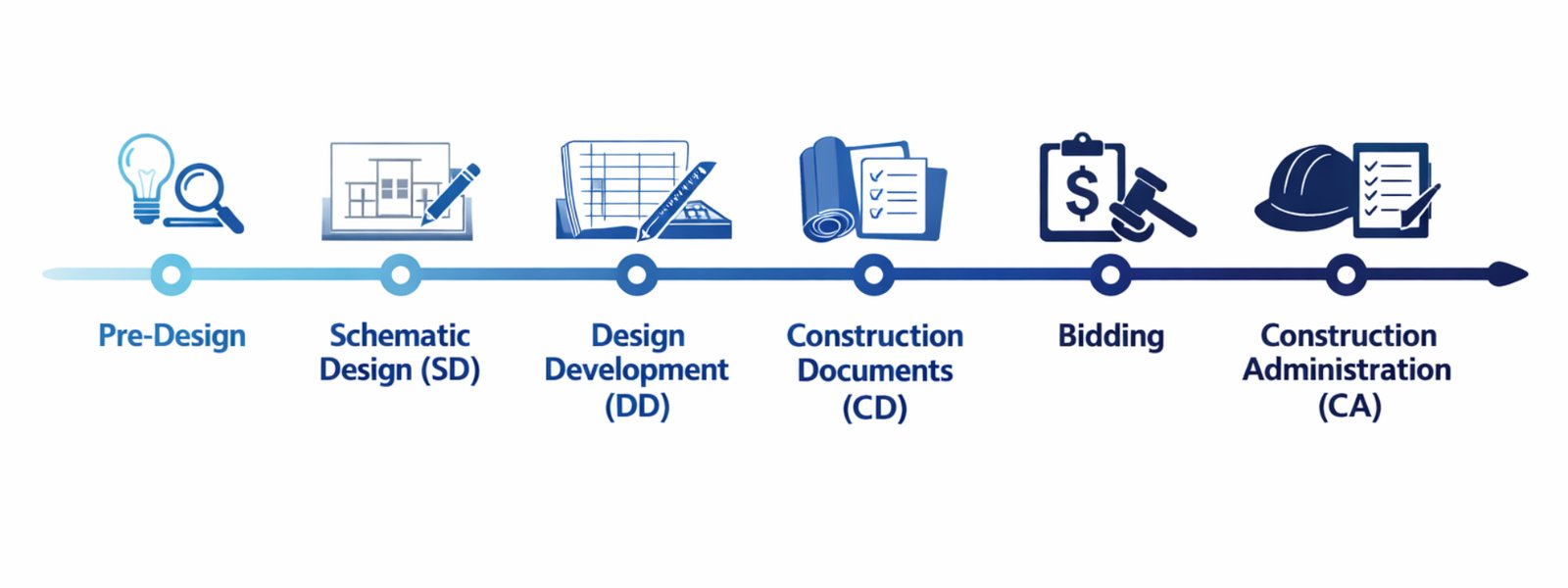
The American Institute of Architects (AIA) defines a clear project delivery framework that most US firms follow, with some variation based on project type and owner preferences. These phases are:
- Pre-Design / Programming
- Schematic Design (SD)
- Design Development (DD)
- Construction Documents (CD)
- Bidding and Negotiation
- Construction Administration (CA)
Each phase has specific goals, deliverables, and stakeholder checkpoints. Missing or rushing through any one of them creates downstream risks, including costly redesigns, permit rejections, or contractor disputes during construction.
Phase 1: Pre-Design and Programming
Before a single line is drawn, architects must understand what the project needs to accomplish. Pre-design, also called programming or project definition, is the intelligence-gathering phase. Here, the design team works directly with the owner to define space requirements, functional relationships, budget constraints, zoning considerations, and schedule expectations.
Key activities in this phase include site analysis, review of applicable building codes and zoning ordinances, establishing gross square footage targets per space type, confirming project delivery method (design-bid-build, design-build, CM at risk), and aligning on sustainability goals such as LEED or WELL certification targets.
Deliverables typically include a written program document, site feasibility studies, and a preliminary project budget. In BIM-forward offices, this is also when the BIM Execution Plan (BEP) is drafted, outlining software platforms, model authoring responsibilities, and Level of Development (LOD) expectations for each phase.
Phase 2: Schematic Design
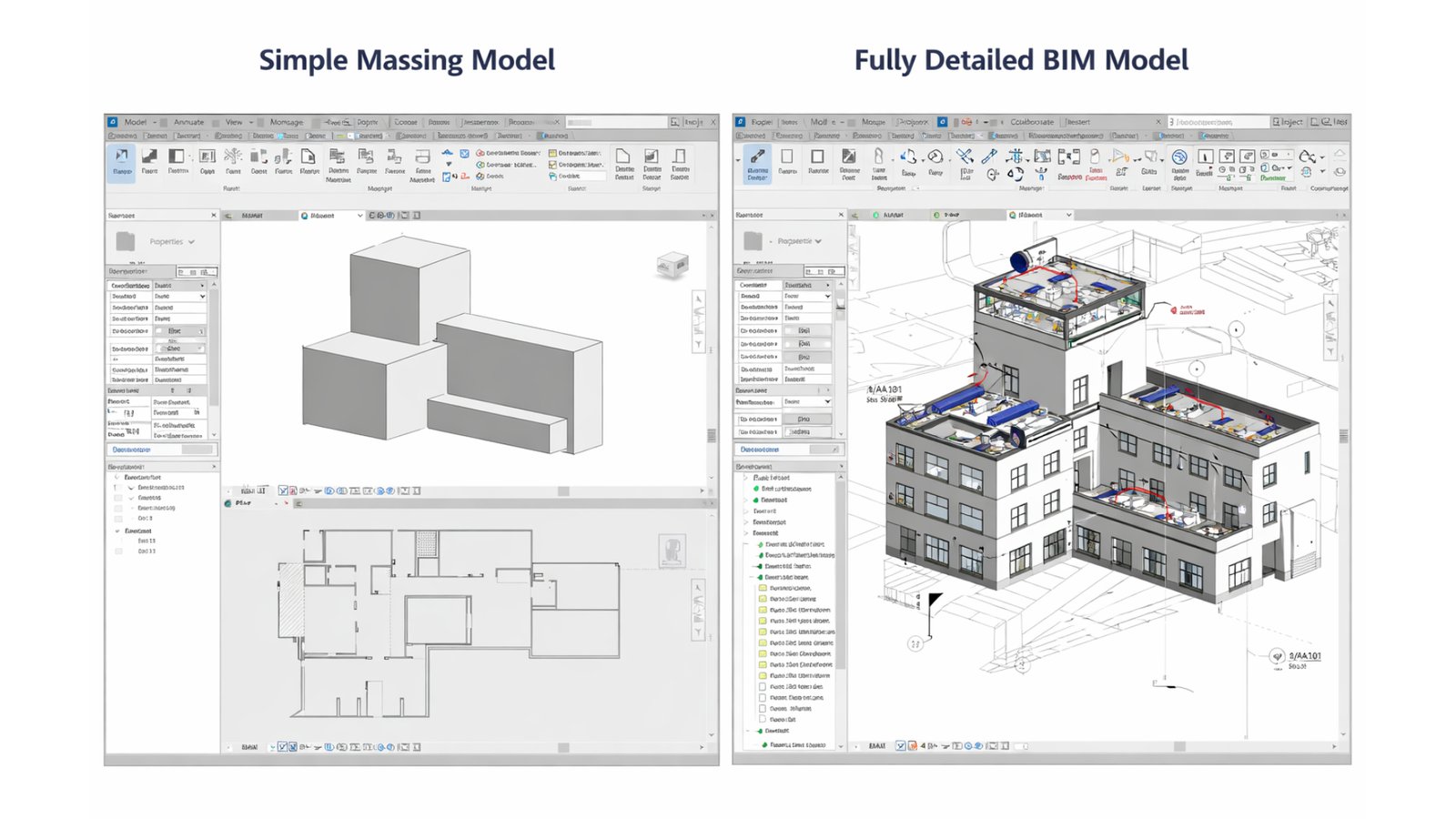
Schematic Design is where the concept takes physical form. This phase translates the program into initial spatial layouts, massing studies, and preliminary structural and MEP (mechanical, electrical, plumbing) systems concepts. The goal is not to finalize details but to establish the overall design direction and confirm that the project is feasible within the established budget and site constraints.
In traditional workflows, SD deliverables included hand-drawn or 2D CAD floor plans, elevations, and sections at a small scale. In modern BIM-driven practice, schematic design in BIM means the architectural team is building a 3D model from day one. Autodesk Revit and other BIM platforms allow architects to generate floor plans, sections, and elevations simultaneously from a single model, dramatically improving coordination efficiency.
Typical SD Deliverables
- Site plan showing building footprint and access
- Floor plans at 1/16″ or 1/8″ scale
- Exterior elevations and building sections
- Preliminary material and systems narratives
- Updated project cost estimate (often by a cost estimator or contractor)
- Owner design review and sign-off
Owner approval at the end of Schematic Design is a critical contractual milestone. Changes made after SD approval typically trigger additional service fees, which is why clear documentation and communication matter at this stage.
Phase 3: Design Development and Its Role in BIM
Design Development is the technical refinement phase. It takes the approved schematic design and develops it into a more complete, coordinated set of drawings and specifications. This is where the design team resolves most of the major technical decisions, from structural system details and MEP coordination to exterior envelope assemblies and interior finishes.
Design development in BIM has fundamentally changed how this phase operates. With multiple engineering disciplines (structural, mechanical, electrical, plumbing, fire protection) all working in a coordinated BIM environment, clash detection becomes a live process rather than a late-stage discovery. Federated models allow project teams to run automated interference checks using tools like Autodesk Navisworks, catching conflicts between ductwork, structural framing, and plumbing systems before they become field problems.
According to Autodesk’s BIM documentation, BIM design phases allow teams to simulate building performance, analyze energy efficiency, and coordinate complex systems with a level of precision that 2D CAD workflows simply cannot match.
Key DD Activities
- Structural system fully defined and coordinated
- MEP systems sized and routed through the model
- Exterior wall assemblies and fenestration details resolved
- Door, window, and hardware schedules drafted
- Outline specifications written for all major building systems
- Updated cost estimate confirming project budget alignment
- Accessibility (ADA) compliance review
Many US jurisdictions allow or require Design Development documents for early permit pre-application meetings, which can significantly compress the overall project schedule.
Phase 4: Construction Documents – The Core of the Construction Drawing Process
Construction Documents represent the full and final graphic and written description of the project. This is the phase that most people outside the design profession associate with architecture: the thick set of drawings and specifications that contractors use to build from and that building departments review for permit issuance.
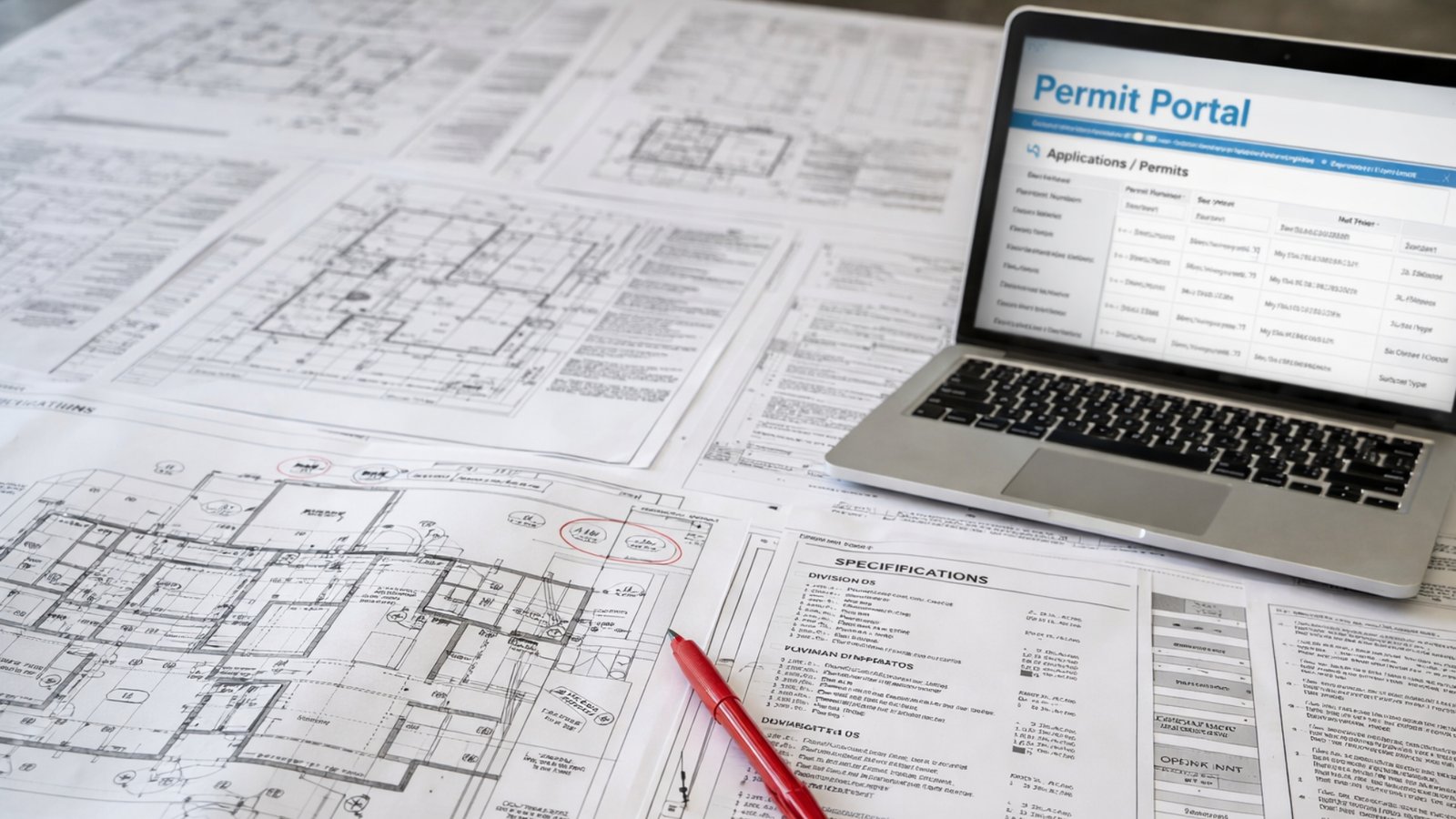
The construction drawing process is comprehensive. CD packages typically include architectural, structural, civil, mechanical, electrical, plumbing, and fire protection drawings, along with a complete project manual containing Division 01 through Division 33 specifications written in conformance with the Construction Specifications Institute (CSI) MasterFormat.
What the CD Package Must Contain?
- Cover sheet with project data, code summary, and drawing index
- Site and civil drawings including grading, utilities, and landscaping
- Architectural floor plans at 1/8″ or 1/4″ scale with full dimensions
- Reflected ceiling plans showing finishes, lighting, and mechanical diffusers
- Interior and exterior elevations fully annotated
- Wall sections, building sections, and stair/elevator sections
- Detail sheets covering connections, transitions, and assemblies
- Door, window, room finish, equipment, and plumbing fixture schedules
- Structural drawings including foundation plan, framing plans, and connection details
- Full MEP drawings coordinated with the architectural model
- Complete project specifications
In a BIM workflow, construction documents are extracted directly from the federated model. Floor plans, sections, elevations, and schedules are all live views into the model data, which means updates to the model propagate automatically across all sheets. This significantly reduces the risk of coordination errors that were common in 2D CAD production.
The CD phase is also where the team achieves the appropriate Level of Development (LOD) as defined in the BIMForum LOD Specification. Most construction document sets require elements modeled to LOD 350 or LOD 400, meaning geometry is accurate enough to coordinate installation and fabrication.
Phase 5: Bidding, Permitting, and Negotiation
Once the CD package is complete, it is submitted to the authority having jurisdiction (AHJ) for building permit review and issued to general contractors for competitive bidding or negotiated pricing.
The design team’s role during this phase includes responding to plan check comments from the building department, issuing addenda to clarify or correct documents during the bid period, and participating in pre-bid conferences to answer contractor questions. In complex projects, the structural engineer may also submit deferred submittals (such as shop drawings for specialty structural systems) for separate permit review.
Permit timelines vary enormously across US jurisdictions. A straightforward commercial tenant improvement in a smaller city might be approved over the counter in a day, while a complex new building in a major urban market can take twelve to eighteen months or more through plan check.
Phase 6: Construction Administration
Construction Administration is the bridge between design intent and built reality. During this phase, the architect and engineering consultants make site visits to observe the work, review and respond to submittals and shop drawings, issue responses to Requests for Information (RFIs), and evaluate contractor requests for substitutions or change orders.
BIM continues to play an active role in CA. Contractors often use the design BIM model as a foundation for their own construction and coordination models, clash-detecting MEP rough-in against structure and architecture in real time. Some owners require as-built BIM models at project closeout, which means the design team may need to update the original model to reflect field conditions.
The American Institute of Architects defines the architect’s standard of care during CA as making periodic site visits, not continuous supervision. Understanding this distinction is critical for defining scope and managing liability.

How BIM Design Phases Have Transformed the Entire Process?
The integration of BIM across all design phases has not merely changed the tools architects use. It has fundamentally restructured how information flows through a project and when critical decisions are made. In traditional workflows, many coordination problems were only discovered during construction. With BIM design phases, the discovery of conflicts has moved from the field to the computer screen, where corrections cost a fraction of the price.
Key advantages of a BIM-integrated design workflow include consistent model-based coordination across all disciplines, automated quantity takeoffs feeding cost estimates at each phase, energy and daylighting analysis embedded in the design process, faster and more accurate production of construction documents, and richer data handoff to owners and facility managers at closeout.
For architects managing projects under tight schedules, the discipline-specific LOD requirements tied to each phase provide a clear quality benchmark. Teams know exactly how detailed the structural framing needs to be at DD versus CD, which prevents both under-modeling (leading to coordination surprises) and over-modeling (wasting production time on details not yet needed).
Conclusion: The Design Phase Roadmap as a Project Management Tool
For architects and design professionals in the United States, the standard design phases are more than a workflow framework. They are a project management and risk management tool. Each phase has clearly defined inputs, outputs, and approval gates that, when respected, produce better buildings, healthier client relationships, and more predictable construction outcomes.
As BIM design phases continue to evolve with technologies like generative design, digital twin integration, and AI-assisted documentation, the fundamental logic of moving from concept to construction drawings through a structured, reviewed, and approved sequence remains unchanged. The tools evolve; the discipline of the process endures.
Whether you are an intern just learning the profession or a project architect managing multiple complex jobs, mastering the construction drawing process at every phase is the single most reliable path to delivering projects that get built as designed.