


As Dubai accelerates toward its 2040 Urban Master Plan and project complexity reaches new heights, the most decisive real estate developers are learning that projects are won or lost before a single pile is driven.
For: Real Estate Developers, General Contractors & Project Owners | UAE Construction Industry | ~1,600 Words
Dubai’s construction sector is one of the most active and demanding in the world. With AED 33 billion worth of projects awarded in 2024 alone, and developments ranging from ultra-luxury residential towers on Palm Jebel Ali to large-scale infrastructure under the Dubai 2040 Urban Master Plan, real estate developers operating in the UAE face a level of project complexity, regulatory expectation, and investor scrutiny that leaves little margin for error.
Yet a significant share of cost overruns, schedule delays, and quality failures in the GCC construction market trace back not to what happens on site, but to what was never properly resolved before construction began. The response from leading developers in Dubai and across the Emirates is clear and accelerating: deeper, earlier, and more technology-driven pre-construction planning.
At the core of this shift is Building Information Modeling, a technology mandate that Dubai itself has codified into law — and one that forward-thinking developers are now treating not as a compliance requirement, but as a strategic asset.
| 30%
Reduction in design-related RFIs reported by UAE developers using BIM pre-construction coordination |
AED 33B
Value of construction contracts awarded in Dubai in 2024, underscoring the scale of pre-construction stakes |
2040
Dubai Urban Master Plan driving a new wave of mixed-use, transit-oriented, and sustainable development |
Dubai’s BIM Mandate: Compliance Is the Floor, Not the Ceiling
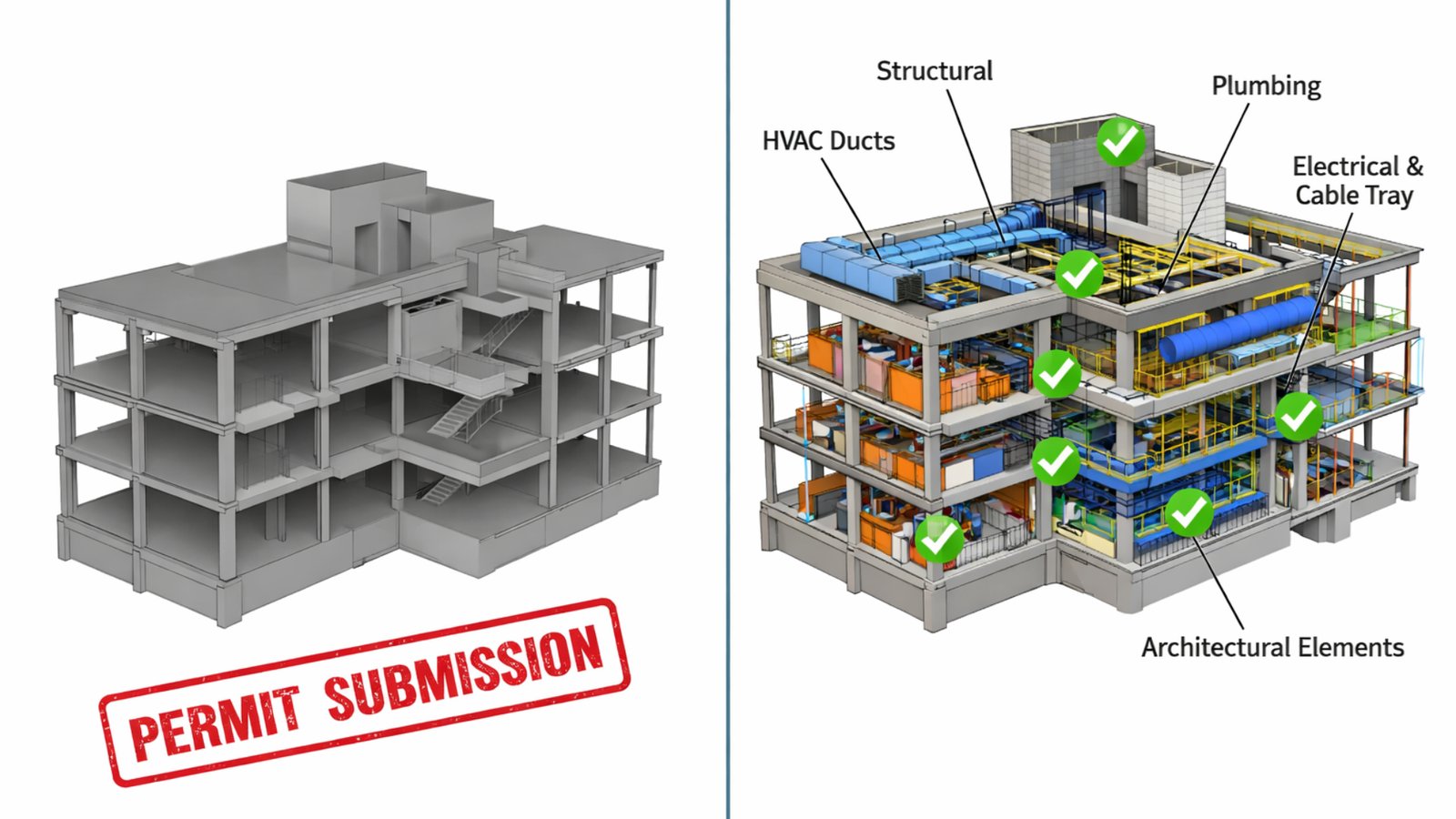
Unlike many markets where BIM adoption is voluntary or incentive-driven, Dubai has embedded it directly into the regulatory framework. Dubai Municipality introduced its BIM requirements in 2015, mandating BIM Level 2 submissions for all government buildings and major private developments above a defined area threshold. The Dubai Civil Aviation Authority, DEWA, and key free zone authorities have followed with their own digital submission standards.
| Dubai Municipality BIM Requirements — Key Points
All building permit applications for developments exceeding 20 floors or 200,000 sq ft GFA require BIM-compliant model submissions through Dubai’s Ejari and DM e-Services platforms. Models must meet defined Level of Development (LOD) standards at each design stage. Developers who treat these requirements as a box-ticking exercise typically submit models that pass review but fail to deliver the coordination and constructability value that BIM is designed to provide. Developers who invest in genuine pre-construction planning in BIM extract both the compliance benefit and the operational one. |
The distinction matters enormously. A BIM model created purely to satisfy a permit submission is a documentation artifact. A BIM model developed through a rigorous pre-construction process is a decision-making environment — one that has resolved clashes, validated procurement timelines, quantified costs, and confirmed constructability before any mobilization cost is committed.
What Pre-Construction Planning Actually Involves in the UAE Context?
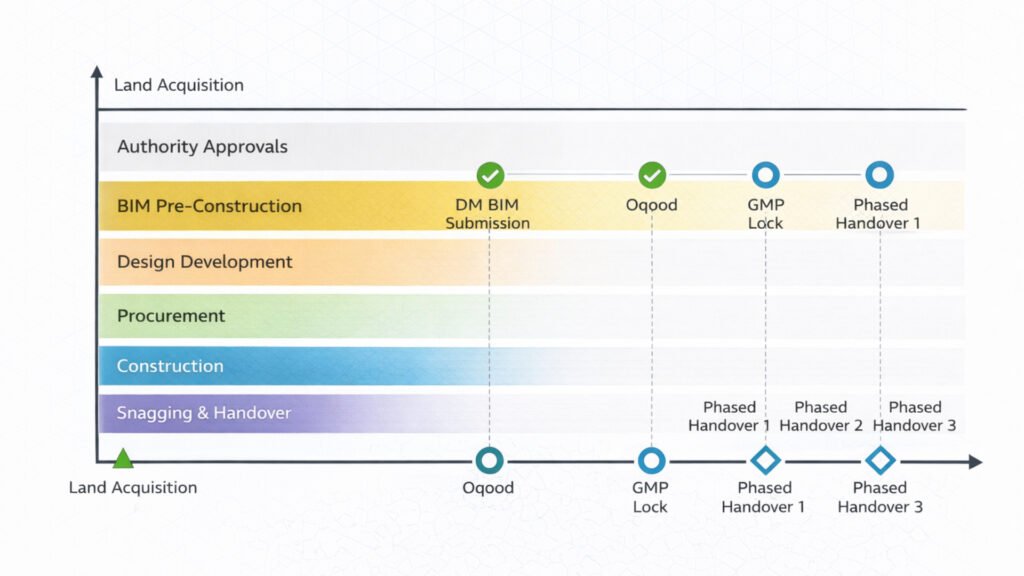
Pre-construction is the structured phase of analysis, coordination, and risk resolution that determines whether a project is viable, deliverable, and profitable before ground is broken. In Dubai’s market, this phase carries additional layers of complexity: multi-authority permit approvals, district-specific planning controls (DIFC, DMCC, Emaar Districts), geotechnical conditions, extreme heat impacting concrete scheduling, and supply chains that draw from Asia, Europe, and the wider GCC.
| PRE-CONSTRUCTION PHASE ACTIVITIES — UAE PROJECT CONTEXT | |
| Site & Regulatory Analysis | Zoning verification under Dubai Municipality and master developer guidelines, authority pre-approval mapping (DM, RTA, DEWA, Etisalat/Du, Civil Defence), and geotechnical review integrated into the BIM site model. |
| BIM Coordination | Multi-disciplinary clash detection across architectural, structural, MEP, and facade systems using platforms such as Autodesk BIM 360 / Autodesk Construction Cloud. Resolving conflicts in the model costs a fraction of field rework. |
| Model-Based Estimating | Quantity takeoffs generated directly from the BIM model, reducing manual error and enabling real-time value engineering as design alternatives are explored. Critical for GMP submissions and investor pro forma accuracy. |
| Procurement Strategy | Early identification of long-lead items (glazing, elevators, specialist MEP equipment) for advance procurement — critical in Dubai’s market where port logistics and import lead times can extend 18 to 26 weeks. |
The Financial Case for BIM in Real Estate Development
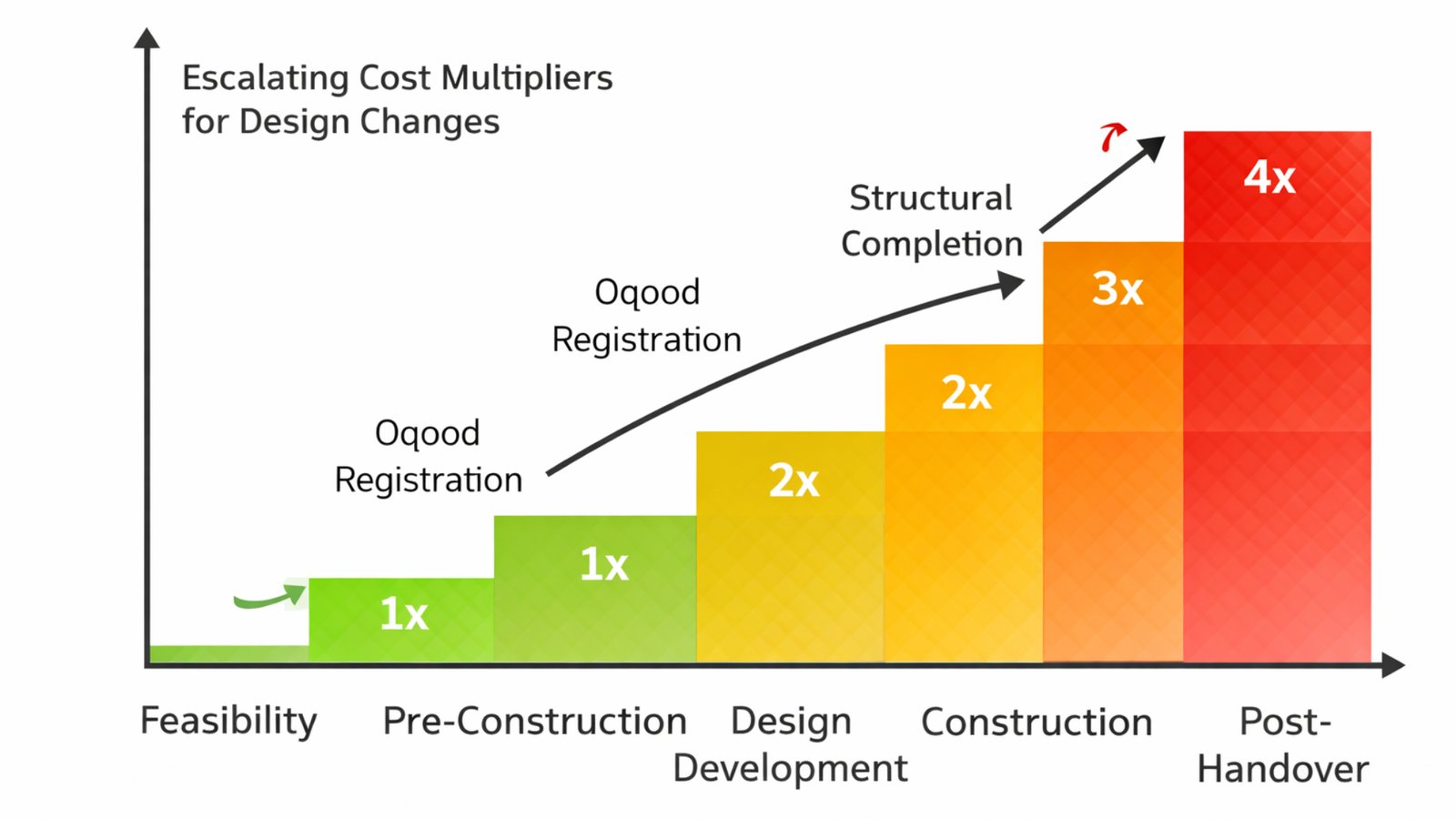
The core financial argument for investing in BIM for real estate developers in Dubai rests on a well-documented cost-of-change principle: the expense of resolving a design error compounds dramatically at each phase of the project. A clash identified in a pre-construction BIM coordination session costs a few hours of consultant time. The same clash discovered during MEP installation on the 30th floor of a tower costs days of rework, material waste, crane time, and subcontractor disputes.
For Dubai developers specifically, the financial stakes extend beyond construction cost. Handover penalties, service charge shortfalls, and RERA compliance requirements for Oqood-registered off-plan projects mean that schedule overruns have direct legal and financial consequences. A project that enters construction with an under-validated design is a project with a statistically higher probability of missing its registered completion date.
In Dubai’s off-plan market, the completion date is a legal commitment. Pre-construction BIM planning is how serious developers protect that commitment before the first slab is poured.
Value Engineering Without Design Compromise
One of the most powerful but underutilized applications of pre-construction planning in BIM is structured value engineering. When cost teams can interrogate a live BIM model for quantities and specifications, value engineering becomes a data-driven exercise rather than a subjective negotiation. Developers can explore facade system alternatives, MEP routing changes, or structural span modifications with immediate cost feedback — making better decisions faster, without compromising the design intent that underpins the project’s market positioning.
Why Dubai Developers Are Accelerating Pre-Construction Investment Now?
Several converging forces have made pre-construction investment more urgent in Dubai’s current market cycle than at any prior point.
- Dubai 2040 Urban Master Plan complexity.The plan’s five urban nodes and its emphasis on sustainable, transit-oriented density require developments that are more technically complex than previous cycles. Pre-construction BIM coordination is no longer optional for projects of this ambition.
- Off-plan sales accountability.With RERA actively enforcing escrow release milestones and Oqood registration requirements, developers who enter construction with validated schedules and budgets are better positioned to meet payment milestone triggers and maintain investor confidence.
- Material and logistics volatility.Post-pandemic supply chain disruption has fundamentally changed procurement timelines for specialist materials in the UAE. BIM-driven pre-construction procurement planning allows developers to identify and act on long-lead items months before they become critical path risks.
- Sustainability and Green Building requirements.Al Sa’fat (Dubai’s green building rating system) and Estidama compliance in Abu Dhabi require energy performance modeling and material specifications that are most efficiently managed within the BIM pre-construction environment.
- Institutional capital expectations.REITs, sovereign wealth vehicles, and international institutional investors acquiring UAE assets increasingly expect BIM as-built models as part of the asset handover package. The model’s value is highest when it has been maintained from pre-construction through delivery.
The Expo Legacy and the New Standard for Delivery
The successful delivery of Expo 2020 Dubai — an extraordinarily complex multi-venue, multi-authority project delivered on schedule — demonstrated what rigorous pre-construction planning and BIM coordination can achieve at scale in the UAE. Contractors and consultants who worked on the Expo program brought those discipline standards back into the broader Dubai market, raising the baseline expectation for pre-construction rigor among sophisticated developers and project owners.
The National Institute of Building Sciences has consistently documented that BIM adoption in the pre-design and design phases correlates directly with reduced permit review cycles and improved project delivery outcomes — findings that align with the experience of UAE project teams who have embedded BIM from the earliest planning stages.
Integrated Project Delivery in the GCC Context
Leading Dubai developers are increasingly adopting early contractor involvement (ECI) models that bring the main contractor and key specialist subcontractors into the BIM environment during pre-construction. This approach, which echoes the Integrated Project Delivery (IPD) model gaining traction internationally, surfaces constructability issues at the design stage when they are cheapest to resolve.
In Dubai’s market, where the contractor and specialist subcontractor community is sophisticated and internationally experienced, early involvement in pre-construction BIM coordination produces consistently better outcomes than the traditional design-bid-build sequence.
Choosing the Right Pre-Construction BIM Partner in Dubai
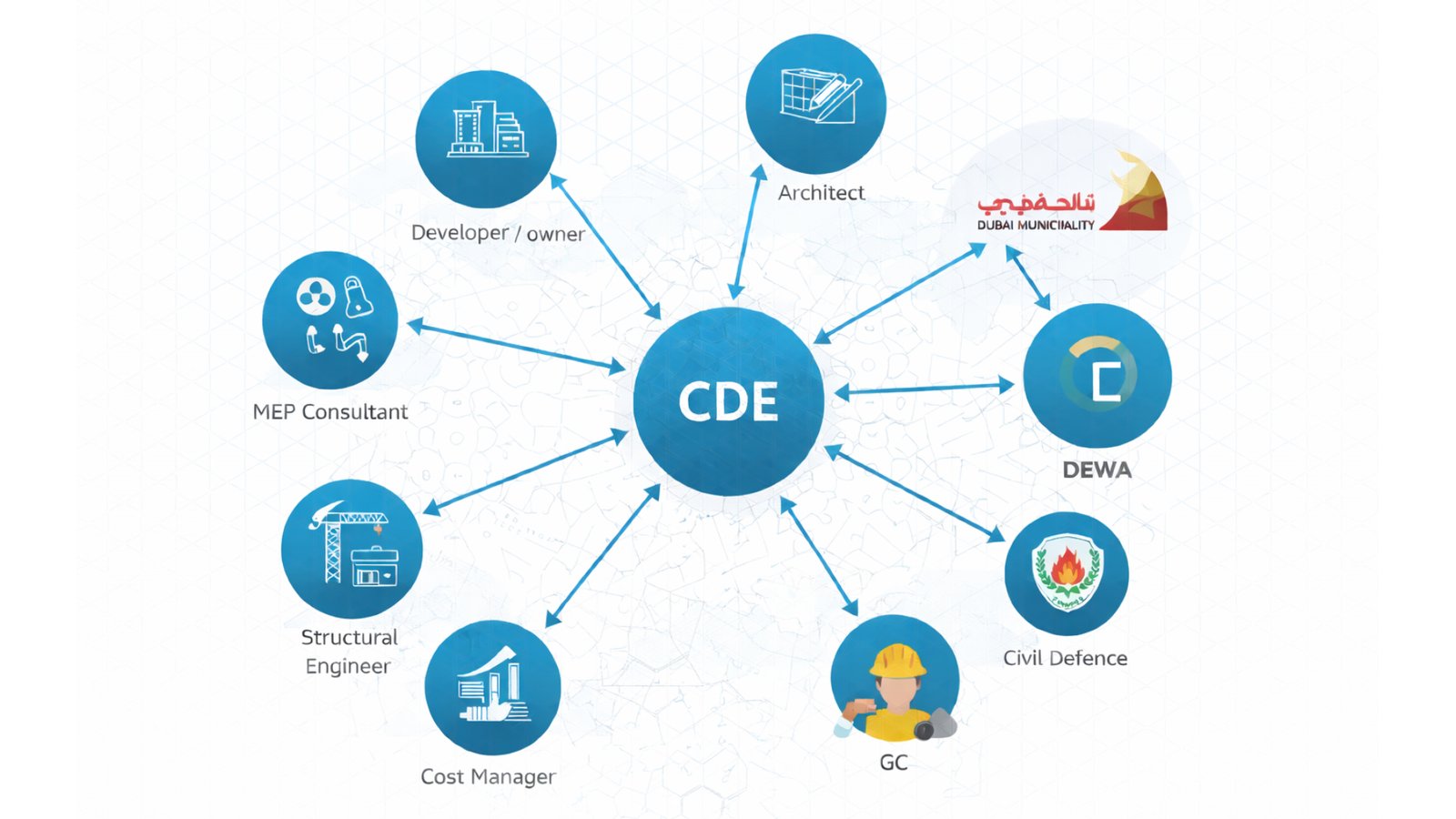
For real estate developers and general contractors evaluating BIM pre-construction services in the UAE, the selection criteria go beyond software capability. The right partner brings three dimensions of value: technical depth in multi-discipline BIM coordination, local regulatory knowledge across DM, DEWA, Civil Defence, and master developer requirements, and commercial experience to translate model data into meaningful cost and schedule certainty.
- Clash detection with formal resolution workflowstied to an RFI tracking system — not just visual clash reports returned to the design team without accountability.
- Authority submission experienceacross Dubai Municipality, Abu Dhabi DMT, and free zone authorities, ensuring BIM deliverables meet the specific LOD and file format requirements of each body.
- Model-based estimatingthat can be reconciled against QS quantity surveys, providing a cross-checked cost baseline rather than a parallel dataset.
- Common Data Environment setupthat gives the developer, design team, and contractor a single version-controlled source of project truth throughout both pre-construction and construction phases.
| Key Takeaway for Dubai Developers
In a market defined by ambitious deadlines, regulatory accountability, and investor transparency, pre-construction planning is the highest-return investment in the project lifecycle. BIM-enabled pre-construction does not simply reduce rework — it creates the cost certainty, schedule confidence, and regulatory readiness that defines a credible, deliverable development in Dubai’s 2026 market environment. |
Conclusion: In Dubai’s Market, Pre-Construction Is Where Returns Are Protected
The UAE’s real estate development industry is in a mature, high-velocity cycle. The developers who will protect margins, meet handover commitments, and build institutional-grade assets are not those who move fastest to site — they are those who invest most rigorously in the phase before it.
Pre-construction planning in BIM is not a cost of doing business in Dubai. It is the mechanism by which serious developers control the business case of every project they undertake. The most expensive building in Dubai is the one that is redesigned during installation. The most successful developers are the ones who have already solved that problem in the model.
At MaRS Design Studio, our pre-construction BIM services are purpose-built for the UAE development environment — combining multi-discipline coordination expertise, deep Dubai Municipality compliance knowledge, and model-based cost and schedule integration to give developers the certainty they need to execute with confidence.